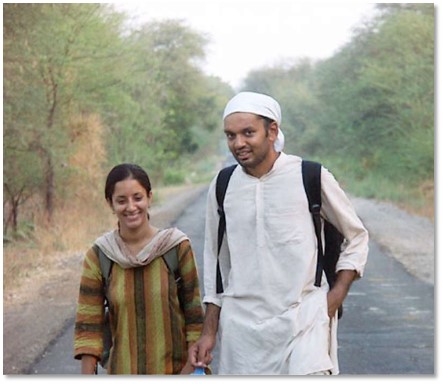
Imagine being fully alive, awake and engaged. Imagine utilizing body, mind and spirit in a rapturous three part harmony that sets feet tapping, hearts beating and souls soaring. Walking together from the self to the selfless, this is one pilgrimage to the heart of the infinite. [about the walk]

2005: State of Gandhi's Khadi

Posted on May 24, 2005 in pilgrim-vedchi.

Khadi. It's a hand-spun cotton cloth made famous by Gandhi's promotion. Fifty years ago, it had a greater market share in India than any other material and today, willing converts are left searching for reasons to wear it.

Many Gandhians like khadi because Gandhi liked it. Most government officials propound it because first, it's their job and second, it generates some employment for "poor". It's questionable if consumers like it, considering that Khadi is less than 1% of the national textile usage, but some are known to wear it because the material is porous.

Today, I ran into the one of the heads of India's Khadi Commission. After a rather confusing series of arguments, I decided to look deeper into the topic. Beyond the emotional, short-term and material reasons, my goal was to understand the rational.

I sit down with a very interesting personality -- a super smart athiest, who is also the grand-daughter of Mahadevbhai Desai, whom Gandhi called his sixth son. Umaben Desai's logic is neither emotional, nor spiritual, nor Gandhian; it's just facts.

Here's the inside scoop on khadi ...

Gandhi promoted Khadi for self sustainability. He wasn't trying to generate employment for the country and neither was he out to create a market about "help the poor" charity. His whole premise was that everyone, rich or poor or in between, should have access to food, shelter and clothing in a self-reliant way. That is, they shouldn't create dependencies on cities, government or economies, lest they get corrupt.

That was Gandhi's idealogy. Decentralized units of self-sustaining ecologies. Simple, long lasting, and corruption free.

With cloth, the idea was to use hand-spun Khadi. The process would be all organic:

  1. Farming: pick your own cotton.
  2. Ginning: remove the seeds and roll up a sliver of cotton.
  3. Spinning: use the sliver and a manual "charkha", to create yarn.
  4. Weaving: weave the yarn into cloth.
  5. Stiching: tailor clothes from the yarn.

Each person needs no more than 25 meters of cloth per year, which can make 3 pairs of clothes, a towel and a sheet. If a person spins for 8 hours a day for 3 days, you will have enough yarn to make your annual quota of 25 meters of Khadi. Then, a community weaver, will weave the yarn into cloth and a local tailor can stich the clothes. (For the ambitious, weaving and stitching can be learned in a matter of couple months.) Since no part of this process requires fancy gadgetry or non-local materials, each of the 700,000 villages of India can be self dependent for their clothing.

That is, of course, the theory.

Khadi, over the 50 years, has taken interesting -- and I should say irrational -- twists and turns.

First myth about Khadi: it helps the poor. According to Gandhi, the poor don't really need your help. But for argument sake, let's say that the city folks want to wear khadi; they don't have the time or the inclination to spin it, but they want to buy it. So, government steps in and says, "Ah, we can do employment generation with khadi." Annually, 600 crores (6 billion) rupees of Khadi is purchased by consumers, so perhaps that money can employ the 40% unemployed villagers of India.

If we stopped there, it could be pitched as a reasonable argument. Of course, we didn't. In our unsatiable quest for efficiency, the question we asked next was: how can we increase the production of Khadi? Unfortunately, people asking the question weren't thinking about self-sustenance, but rather of competing with the textile mills that held 99% of the market share.

Since you can't motorize hand-spinning, experts in the field decided to innovate the "charka" (the spinning wheels) that are used to create khadi. Ambar-charka is the name of the latest spinning wheel that is still hand-powered but 8x more efficient because of its 4 spindles.

Because the Ambar-charka wasn't coupled with an 8x increase in khadi demand, it simply killed 8x of the villager jobs. And in fact, it not only killed the jobs, but also the villagers themselves. In cities like Nagpur and states like Andhra Pradesh, hundreds of weavers and spinners committed suicides in the late 70s.

Technoloy, innovation, efficiency is not to be discarded. But if these advances are created in profit-making silos, it anhilates the cultural fabric of an ecosystem and eventually, runs the risk of destroying the entire ecosystem itself.

When most people think of cotton, they think white. No one in this generation will even remember that cotton naturally grows in many other colors like brown and yellow. Because of the heavy textile demand for white cotton, all farmers started producing white cotton. Moreover, the heavy cotton consumption by the mills created an imbalance in the natural ecology; as a result, 80% of all pesticides used in Indian farms are used on cotton farms! Eighty percent.

To "efficiently" transport cotton to centralized mills, it is compressed. Then, at the farms, lots of energy is spent in carding the cotton to make it fluffy again.

Most khadi producers now use "new and improved" Ambar-charka in India. You can't blame the producers in a land where more than 350 million people live on less than dollar a day; they are just trying to survive. But the confusion of the government policies, technologists and pundits are creating these weird hybrid solutions that are simply not khadi. Not only are Ambar-charka machine parts hard to maintain, it also requires long-staple cotton sliver that is used by textile mills. The same long-staple cotton that has increased the use of pesticides, destroyed cotton bio diversity, and created many subtle forms of inefficiencies. So this kind of a khadi movement is far cry from Gandhi's vision of self reliance.

Government provides rebates to subsidize the cost of hand-spun khadi; but greedy institutions have now created a hybrid khadi-polyster that also qualifies for the rebates. Consumers, as a result, don't have a clue as to why buy Khadi. Khadi propaganda says that Khadi generates employment for the poor and that it's a material that "breathes". Surely, Khadi is thick to provide insulation in the winter and porous to provide ventilation in the summers; and it feels good to wear. But when I spoke to various youth groups around the state of Gujarat, they told me the most practical reason for not buying khadi: it's expensive.

At present, Khadi is a bit more expensive today and that can change with the right policies and better marketing; still, just as an orginal painting will never be as cheap as a print, hand-spun khadi and block printing won't ever be able to compete with a 80 rupee t-shirt made from synthetic material. But if production of the chemical dyes used to color our t-shirts will ruin the rivers, if the mass cotton production will ruin the land, and the lack of jobs will ruin the lives of the common man, the questions really is: is it worth it? No. No one in their right minds will think so.

Root of the problem, though, is that "khadi" itself is in a state of mess. Gandhians have become idealists whose message is largely disregarded by the consumeristic mainstream. Village producers are just trying to make their daily livelihood. Consumers are getting mixed signals from the government policies, propaganda and competition attempts against the textile industry; to top it off, no one has paid any attention to fashion in khadi. Government is trying to increase jobs and provide rebates but the head of Khadi commission himself admitted to me, "Our biggest problem is that we don't know how to get the help to the right person." That is to say, there is no infrastructure to implement policies.

Khadi stood for decentralized sustenance. But with the Ambar-charka, and lack of accompanying increase in wages or jobs or khadi demand (all of which can potentially be blamed on the government policy), khadi was left neither here nor there. Khadi pundits came out and declared, "Khadi will soon take over the textile market." Instead of remembering the principles of Khadi, they started creating extravagant shows, setting up huge infrastructures, and entering a centralized marketing system that they were ill-equiped to fight, that Khadi never stood for. Not only are they losing the fight, but they are in the wrong war.

Gandhi once said, "Live simply, so others can simply live." His interest wasn't in selling khadi and marketing consumerism. He wanted the common man to be self reliant, to be free from market forces to think for himself, to be alive in ways that are natural to them. Perhaps Gandhi's message is too revolutionary for our times.


Comments ...


1.
On May 24, 2005 Dattaauntie wrote:

Nipun! Thanks for the research and I am pleased with your good work. I grew up spinning the Charkha and your article was eyeopener. All the best...and God's blessings are with you.....
Dattaauntie.


2.
On May 24, 2005 yaniv wrote:

Hmm,

Very interesting post. What sparked my interest were the few sentances on Ghandi's vision of 'decentralized units of self-sustaining ecologies.'

One of Paramahansa Yogananda's life visions were the creations of what he called "World Brotherhood Colonies," communities which would allow for householders and non-ascetics alike to live together in a self-sustaining manner with the core understanding that life here is only for the purpose of Spiritual seeking and action in this world all to be Spiritual practice.

Yogananda went so far as to publicly prophecy that this is to be the new model of living which will rise out of the ash-heap of modern day greed/power societal organization.

One of Yogananda's close disciples, Swami Kriyananda actually founded one of these communities, Ananda, which nearly 40 years later, is still thriving.

On a similar note, the Spiritual Master Shrii Shrii Anandamurti also spoke of the need to develop 'Master Units' following much of the same principles.


3.
On May 25, 2005 karen wrote:

I'm here at your home (Viral is here showing me how to work these blogs :-)) and wanted to tell you how very much your blogs and writings (from both you and Guri) have meant to me. It's been a deeply moving experience.

I wish you all blessings and love!

karen


4.
On May 27, 2005 Matt wrote:

Nipun, interesting post. Couple of thoughts:
1) If Gandhian economics promotes proximity of consumption and production, so as to cut out middle men, why do you think that Cshops would be a good model? It seems to me that Cshops is a middle man that attempts to sell products half way around the world from where they are made. Hopefully you will answer that when you write more on this model. :)
2) What is the environmental impact of this philosophy? By that I mean, does having a lot of small farmers raising cotton take more or less land, water, and pesticides per lb of cotton produced than a couple of large farms?
3) Doesn't this theory of self reliance mean that instead of specializing and taking advantage of your best skills, everyone ends up using the same skills? Wouldn't it be better if villagers could specialize it what they do best? Instead of everyone growing their own cotton and making their own clothes, only a couple people do it, but they do it better because they are able to spend all of their time on it. Likewise, others are freed up to spend their time and energy specializing at other tasks: teachers, doctors, scientists, construction workers, artists, shop keepers and pilgrimaging yogis.
Put another way, wouldn't it be better if everyone on the village could rely on others in the village and the cities and the government? Shouldn't the answer to corrupt government be transparency and good government, not no government? Don't you have to be reliant on someone to get roads, access to water, and electricity? And doesn't economic reliance or trade between countries make them less likely to go to war with each other?


5.
On Jun 02, 2005 Arpita Sheth wrote:

Nipun,

This is interesting. I have sent you an email at nipun@charityfocus.org requesting some information on purchasing Khadi. Please respond at your convenience.

Thanks for sharing!
Arpita.


6.
On Jun 26, 2005 s.padmanabhan wrote:

Hello Nipun, Your web site and comments in relation to khadi was quite interesting and for me it brought nostalgic memories of my association with the khadi commission between 1955 & 1974 in India. I have noticed that people blame Gandhi & say he was not practical to promote the cloth Khadi as a means to create self sufficiency in villages. I understood that Gandhi's advocacy of the need to take up spinning and weaving was to provide local employment to villagers, so that it would hopefully eliminate or at least reduce unwanted crowding of the cities by unemployed & underemployed villagers causing more social ills.Also Gandhiji wanted to boycott the foreign made mill cloth of lancashire as one more weapon in his arsenal of non-violent agitation for freedom. This philosophical approach of Gandhiji was relevent in his times.Times change so do people's lifestyle & aspirations.
You might have known also in the event of massive labour layoffs by the big mills, such as the one that happened in Ahmedabad, it was the decentralised sector that provided some relief to these mill workers in khadi schemes.If people think subsidies to Khadi & village industries are not justified considering their viability, The powerful corporate sector in India gets more than it's share of the tax rebates etc. Probably it is a timely matter to look into the balance of economic, social & ecological between the growth & sustenance in the urban as well as the rural which accounts for 80% of india population. We all know that Khadi is no more considered to be the sacred attire of sincere leaders who has diasappointed the masses with their hypocracy. Pl. excuse my rambling comments. I enjoyed your thought provoking writeups. Padmanabhan


7.
On Sep 26, 2005 Swarna wrote:

Nipun, Amazingly few people, even among the literate lot, realise that by using the charka Gandhiji was only showing the way to being self-reliant. In these days when everyone is in a hurry to get to the future first(!), I believe that the ckarka is a way to slow down and indulge in 'high thinking'. Can you tell me where to buy one from, pl?
Regards and best wishes
Swarna


8.
On Sep 26, 2005 Swarna wrote:

Wonder if you have come across the book 'Divine Nature' by Michael Cremo and Mukunda Goswami.
Regards


9.
On Feb 07, 2006 Sunaina wrote:

I work with khadi, i.e. styling it into contemporary clothes for women and giving presentations on the subject of khadi; I enjoyed reading your write up and and learnt something new from other readers' comments as well.

thank you!


10.
On Dec 07, 2006 akshay wrote:

Nipun,

I googled for material on gandhian economy and came across your blog. Clearly, its an amazing piece of true analysis in the world where we have reduced gandhism to 'lage raho munnabhai'. your last lines according to me are true purport of gandhi philosphy..to be free from market forces because that is what is taking us away from nature, reality and psychologically colonising us where no individuals or set of indicisuals but a 'capitalist system'is getting stronger than humans. I would like to be associated with activism related to gandhian economics and gandhian philosphy or do something in relation to it including study more about it!! I a a lawyer by profession and my mail is akshaynagpal22@yahoo.com. Would love to be in touch with you or any one else who could guide me in this direction.


11.
On Dec 07, 2006 akshay wrote:

In continuation of my post...I would also like you to answer the question 4 in particular because I feel that it is one of the most strong arguments contradicting gandhian phiolosphy and economy of self reilant because the justification that industriliazation takes is that to cope with the pressures of population it is necessary to industrialize for resource efficiency. Its a different matter that in that process today we end up wasting resources. looking forward to your reply


12.
On Jan 28, 2007 archana wrote:

gr888888888 job man, would definately want to know more about khadi. so if u have any more information plzzzzzz keep posting and by the way what was the motive of your research. r u into developing khadi or something like tht?????????


13.
On Jan 29, 2007 Sunaina Suneja wrote:

v interesting information, thank you!
I've been designing with khadi for many years now and continue to pick up interesting bits of info as I find them.
I wrote an article for HT City 10 yrs ago as we prepared to celebrate our 50th anniversary of independence.
have you heard of the navjivan trust publication, KHADI, which includes Mahatma Gandhi's writings/thougts on the subject? It's quite a volume.

YOu need to keep this dialogue on khadi alive and kicking!

well done!


14.
On Apr 24, 2007 B.Thyagarajan wrote:

Nipun,
Thank you for this article on Khadi. My father, mother and sisters devoted our lives to Khadi between the years 1934-1945..Everyone of us wore nothing but Khadi clothes. Every one of us spun all the required yarn necessary. and exchanged it with weavers of Tamil Nadu to make the appropriate wearable material...saris, dhotis,etc..but as 1947 came on and each of us grew up with other responsibilties, lack of time not lack of enthusiasm stopped our habit of spinning our own yarn. we still wore Khadi, in spite of the fact, in those days the Khadi materials were so heavy to wear and hard work to wash and dry...
Like Lord Tennyson said, " The old order changeth yielding place to new lest one good custom should corrupt the world ".
with many thanks,
sincerely,
Dr.B.Thyagarajan


15.
On Apr 25, 2007 preeti wrote:

good read...but can you tell how khadi is different from handloom ....in ancient india all weavers were using the hand spun yarn only for weaving...why suddenly this emphasis that this is something great only visualised by gandhi....hand spinning has been a core of all indian traditional weaving techniques...please comment


16.
On Nov 13, 2007 Ridhi wrote:

Dear Nipun,

I'm currently writing an article on the e-charka, which will be launched on Nov 19th by our President. Your posting is very interesting because the 'e' to the already existing charka could pose some interesting developments. Some of the points you made here are very... elucidating.

I'm going to continue scouring the web for more articles like yours. If you have any recommended readings... do let me know. My contact is ridhidcruz@gmail.com

Until then I wish you the best in your travails. Take care. :)


17.
On Dec 08, 2007 sarabjit singh wrote:

hello,thanks! but add some images related to khadi


18.
On Jan 04, 2008 pooja wrote:

thanks for the infomation
i think if we will use khadi with natural dye then we can make eco- friendly products


19.
On Apr 19, 2008 JAWAHAR SETHIA wrote:

DEAR SIR
WE ARE MANUFACTURER HAND SPIND HAND WOVEN, KNITTED KHADI PRODUCT.
PLEASE NOTE: WHAT IS KHADI---
"KHADI" MEANS ANY CLOTH WOVEN ON HANDLOOMS IN INDIA FROM COTTON SILK OR WOOLLEN YARN HAND SPUN OR FROM A MIXTURE OF ANY TWO OR ALL OF SUCH YARNS.
(A) THE VARIETY OF PRODUCT MADE OUT OF ADMIXTURE OF ANY TWO HAND SPUN YARNS SHALL BE DETERMINED ON THE BASIS OF YARN USED IN ITS WARP
(B) HOSIERY PRODUCED FROM HAND SPUN YARN ON HAND OPERATED FLAT BED OR CIRCULAR KNITTING MACHINE SHALL BE KHADI.


20.
On May 28, 2008 Ruchi wrote:

wnt to create online khadi shop.....
send me ur mail ...will talk to u in detail.


21.
On May 29, 2008 Rutam wrote:

Hi,
Your research is a valuable one. I was just searching through the net to get some info on Khadi and its marketability in todays's context, I came across your article. Khadi is marketable. There is a huge potential market. But the only thing one needs to understand, let it be govt agency, that It is not just khadi and its madeups that needs to be modernaise, but the marketing methodology also needs to have a latest management insight. I was writing an article in a newspaper on Khadi and decreasing employment in the sector.
I'd like to have further interaction with you if possible.
bb


Post a Comment


Remember personal info?


Ensure you're human. :) Enter the security code you see below.
: