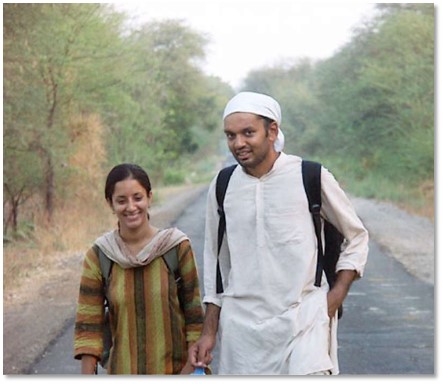
Imagine being fully alive, awake and engaged. Imagine utilizing body, mind and spirit in a rapturous three part harmony that sets feet tapping, hearts beating and souls soaring. Walking together from the self to the selfless, this is one pilgrimage to the heart of the infinite. [about the walk]

Unspoken Contract With a Rickshaw Driver

Posted on October 21, 2005 in pilgrim-post.

"Where to?" the rickshaw driver asks me with his mouth full of tobacco. "Vijay Char Rasta," I say. I'm headed to meet Sampat, Raj and Archana to talk about the purpose of life and things like that. :)

After some light conversation, the rickshaw driver and I quickly become friends. "Are you from Ahmedabad?" he asks me. "No, I'm just visiting a friend." "Just a visit?" "Yeah, he's opening a restaurant and he wanted my parents to inaugurate it. I'm helping him launch the café."

"Café? You mean, it's like a Barista?" he asks showing his knowledge about the trendy coffee joints in town. "No, not quite like Barista. It's called the Seva Café." "Oh, what's that?" "Well, it's a place where everyone is a volunteer, and no one gets charged for their food. It's going back to our cultural roots, where each person is treated as a part of you and not a customer: Atithi Devo Bhava. We start each relationship by giving, and not by thinking of receiving."

As we talk more about the Pay-it-Forward model, the rickshaw driver progressively gets more and more blown away. "I can't believe that such a thing can exist in a world like this. Today, everyone is after money. No one gives. Corruption is everywhere, even in our government. The world needs more people like your friend."

"What's your name, by the way?" I ask the pumped-up rickshaw driver. "Mohan. Don't call me 'kaka' (uncle). I'm like your brother. Call me Mohanbhai."


When I press him a bit about his own life, Mohan goes on to describe his own bad habits. "Sahib, what can I say? It's hard. I know it's bad for me, I've seen all the tobacco related cancer patients in the hospitals but it's hard to let it go." I suppose we're all in the same boat with our bad habits, but Mohan has got honesty working for him.

In between the loud honking horns and the exceptionally noisy rickshaw, Mohan drives slowly in the side of street so we can converse. He even starts singing some poems, in praise of human virtue (I wish I could remember them :)).

"How long have you been in Ahmedabad?" I investigate. He says, "My whole life. We used to have a farm and all in our village, but now I just drive a rickshaw. It's good money."

"About how much money do you make everyday?" "Oh, 200 to 300 rupees daily. It's really good."

Throughout the pilgrimage, this is one thing I noticed -- people with more money are more self-conscious about it. I can't imagine any of my middle or upper class friends volunteering their exact salary information; either they'll fake it to pretend to be "successful" or they'll try to hide their net worth in fear that someone will somehow steal their jewels. For Mohan, though, it was 200-300 rupees a day (minus the operational costs, which he didn't figure in).

Thus far, our conversation has been in pure Gujarati. And then, just out of nowhere, he says, "I am B-com graduate. I speak English." Whooa. And then he reads a couple of the English billboards to happily brag about his skills. A college grad driving a rickshaw? "Oh yeah, this way I take home about 3000 rupees a month for my family. Nothing else gives me that kind of money," Mohan explains.

"How many people in your family?" "Two daughters, one son and my wife," he says with a smile as he describes his loved ones.

On the face of it, Mohan's red-colored teeth, a fake-looking-weird-yellow dyed hair, big eyes and tattered clothing can present a daunting image. But in this conversation, we had entered another dimension of our realities. By now, Mohan and I were almost brothers in service; I was excited to be given a window of insight into the heart of a rickshaw driver and Mohan was enthralled with our conversations on the need for good in the world, examples of meritorious acts, and the heroic experiment of my friend's Seva Café.

Soon enough, my fourteen minute rickshaw ride came to an end. It was time for me to pay for the ride.

"How much?" He checks his meters and reads, "23 rupees."

I look in my wallet and notice that I have the exact change of Rs. 240. That's only 10 rupees less than his daily turnover. Spontaneously, I say, "Mohanbhai, here's 240 rupees. Will you drive your rickshaw in the Seva Café style, today?"

A moment of stunned silence.

I explain, "For the rest of the day, just drive the rickshaw as usual but when it comes time to charge, tell your customers that someone else before them has paid their bill for them and if they want to continue the chain of kindness, they can contribute whatever they want. See what happens."

Mohan still is awestruck. Shaking his head in disbelief, he says, "No sir, no sir, I can't take this." "Why not?" "No, no, sir, you don't understand. I'm a terrible guy. How do you know I won't just take the money and run?"

"Mohanbhai, if I didn't trust you, why would I give you the money?"

"Sahib (boss), don't trust me. I'm a very bad person. No one trusts me," he says while rejecting money and downplaying himself for the next couple of minutes.

To his several minute tirade, I respond with a one-liner and an extra-broad smile on my face: "Too late. I already trust you."

Again, a moment of stunned silence. Mohan doesn't exactly know what to do.

"Ok, sir, tell me your name. I will come and tell you exactly what happened with this money."

"Too late, Mohan. I already trust you fully. You don't need to tell me anything. It will be an unspoken contract between you and the world," I say. One got the sense that he had never experienced such a blatant act of irrational faith. :)

Still, Mohan felt a need to reassure me that he will live up to the faith I had placed in him. After fumbling around for a bit, he gathers money from all the hidden pockets of change; "See, see, I have Rs. 312 on me. You have given me Rs. 240. I will do my honest best today. You can be sure of that. I won't let you down today."

It's hard not to be elated after such encounters. Rs. 240 is worth less than a movie in the US; no movie has ever left me feeling this connected with life.

Right as I was about to go, Mohan throws in his final condition: "Sir, I won't let you go without giving me your name and address. You have to. You can't leave without telling me."

"Mohan, I tell you what. You and your family, you come to the Seva Café some day. You've seen the Reebok building; it's right on the fourth floor. If you come in the next week, I'll be your waiter. Otherwise, ask for Jayeshbhai and tell him you're my friend. He'll know."

He grabs a newspaper from one of his bins, pulls out a pen from under his seat, and writes down a few things in Gujarati. "One day, bhai, I will find you and tell you all my stories." Almost silently, he whispers, "Thank you."

"See you, my friend," I say while walking off. He smiles, snaps his fingers and lifts his right index finger towards the sky. I don't know what it meant, but maybe it was the seal on our unspoken contract.


Comments ...


1.
On Oct 21, 2005 Rajeev wrote:

Nipun,

It just amazes me the way you can give everything in your wallet with all the trust and love!!!

It just is too inspiring...wish I could be that way...someday!

love and regards,

Rajeev


2.
On Oct 21, 2005 Fred wrote:

Wow what a great story! Maybe someday I'll be able to come check out Seva cafe, and get a ride from an inspired cabbie! :)


3.
On Oct 22, 2005 Liza wrote:

hey nipun,

it amazes me the way you are able to connect to people and bring out the best in them!! thanks for sharing these experiences and inspiring us all.

love,
Liza


4.
On Oct 22, 2005 Manju Gupta wrote:

The seva XXXX concept is the lab work of following Kabir's doha in action.

dharam kiyee dhan naa ghate
ghate naa nadI ka neer
apaN ankeN dekh lo
keh gayee Daas KabIr

Literal Translation:

doing "dharam" does not reduce personal wealth
cannot reduce flowing river's water
see it with your own eyes (experience it for one self)
says daas kabIr


5.
On Oct 24, 2005 juhi wrote:

wow.... nipun, i just want to say THANK YOU.

thank you.


6.
On Oct 24, 2005 Vam wrote:

What a wonderful and touching story. The concept of the Seva Cafe is truly amazing...carry on.


7.
On Oct 25, 2005 Abhijit wrote:

Looking forward to your update on what Mohanbhai had to say about the experiences in dealing with the Amdavadis on that day.


8.
On Oct 27, 2005 Sima wrote:

Can't WAIT to go to Seva cafe, and see all of these transformed people, from all walks of life- serving people left and right. Put my name down for Dec. 29th or 30th- I'm busing tables!


9.
On Nov 05, 2005 sheetal wrote:

how, how my dear friend do you manage to connect and trust so freely?
love your work, seva stories and the inspiration you provide,
truly
sheetal


10.
On Nov 21, 2005 Mona wrote:

Hi Nipun - i am certainly missing out as i just started reading this blog - but it seems that these stories are timeless and anytime they are found, can leave the reader with some inspiring thoughts. Keep on creating those ripples :)
Smiles,
Mona


11.
On Dec 10, 2005 Hima wrote:

What an absolutely amazing story. Really made my day...


12.
On Dec 10, 2005 Prahar wrote:

hey nipun, your blogs starting to spread into canada... truly a wonderfully touching and inspiring story... random acts of kindness and random encounters with strangers like yours are what can make life most fulfilling...

post an update on how the seva cafe is doing, i'll be in india during christmas id love to get more information and help out...

- Prahar


13.
On Dec 24, 2005 Carey wrote:

What a beautiful story. Rumi says that giving is gainful employment, since it end up bringing in money. You are living his words.

-Carey


14.
On Jul 20, 2006 Bhavin Turakhia wrote:

Wonderfull concept of Opening a Seva Cafe. A great kindness shown with inbelievable faith.


15.
On Jul 14, 2007 Dr Amit Bhatt wrote:

To help people in their difficulties without expecting anything in return is a great virtue.Helping an unknown person is a great Humanitarian act.Serving others selflessly is really great thing.BUT I fail to undersatnd why people want to serve others who are unknown but the same people do not want to help their own family members or friends or neighbours or colleagues? I may go to a restaurant or a hospital or a temple and serve others whom I even dont know you may call it a great act of service.But if I dont even give glass of water to my parents or dont help my wife in house keeping than what is the use of earlier acts of SEWA ?


16.
On Aug 21, 2007 Raksha Bharadia wrote:

Dear Nipun,

I only have one word WOW!

One line I read somewhere comes to mind

"People may not remember what we are or what we do, but they will never forget how we make them feel


Post a Comment


Remember personal info?


Ensure you're human. :) Enter the security code you see below.
: