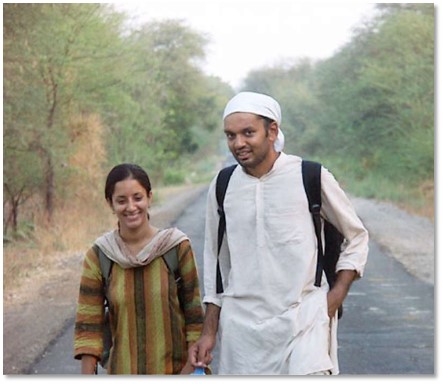
Imagine being fully alive, awake and engaged. Imagine utilizing body, mind and spirit in a rapturous three part harmony that sets feet tapping, hearts beating and souls soaring. Walking together from the self to the selfless, this is one pilgrimage to the heart of the infinite. [about the walk]

Fortune at the Bottom of the Pyramid?

Posted on June 04, 2005 in pilgrim-mumbai.

A bunch of tribals call us into their home to give us water when they see our parched throats and empty water bottles. This is not just regular water; this is water that they walk several hilly kilometers for, between midnight and 2AM, when the water level in the wells are high. Yet, they insist on filling up our water bottles.

Such kindness can take your breath away.

It takes your breath away for two reasons: one, because it's such pure, unadulterated kindness and two, because it's unclear how long this tribal culture will actually survive.

The same, innocent villagers whose spirits are so wide open, are practically being suffocated by us educated, city folks.


Amul Dairy, one of the biggest in India, recently initiated small, rural co-operatives to gather their milk; although villagers now got cows that gave them milk, it made absolutely no impact in the mal-nutrition amongst the village kids. In the cities, you see people lining up to get their Amul milk for 22 rupees a litre; in the villages, you see mom-and-pop farmers bringing their little cans of cow milk in exchange for 7 rupees a litre. Furthermore, to deliver their milk "on time" for the cities, cows are milked at irregular times, not in tune with nature.

So there is some income generation for the villagers, lots of income generation for Amul, much discomfort for the cows, and no change in the village mal-nutrition. Yes, there are short-term benefits of purchasing power as the villagers become service providers for the cities but it's limited in its scope.

First issue is that Amul-type corporates generate more income for themselves than the villagers; but let's excuse that as a consequence of trickle-down economics in a free market. Second, much bigger problem is about what villagers will do with this extra money. Another big corporate gaint will market to the villagers to "show 'em the good life". One corporation provides money, another sucks the money away. Market expansion, village contraction, culture destruction.

Milk is just one thing. But the deeper question really is: does it make sense to mess with cultural fabric of the village, and make it a mini, underprivileged city? They are the ones who provide us grains; they are the ones who care for the forests that give us rain water; they are the ones who have a tradition that is in tune with nature; and they are the ones who have an authentic link to a very ancient heritage.

C. K. Prahlad, a very prominent business intellectual, has written a book called "Fortune at the Bottom of the Pyramid". I'm still trying to figure out the title. Does he mean, go and grab the pot of gold from the poor?!? Perhaps he's simply relaying what is already happening in the industry.

In fact, I've seen it with my own eyes while walking through the villages of Gujarat. Businesses are asking this question: if we can thrive off the 250 million middle and upper class Indians, can we tap into the 750 million, lower class market? Maybe. Step one, of course, is to create the need. In the cities, because of the existing infrastructure, the recipe is simple: throw in billboards of Aishwarya Rai drinking Coke or Michael Jordon wearing Nike shoes and blast Amitabh Bachchan ads on all TV stations and the city population is willingly mesmerized. In the villages, though, it still needs work. You first have to educate them, so they can read all the advertisements and recognize the brands. Then, you have to bring in TV's and radios with centralized programming so the marketing icons are recognized. And if you can't bring theatres to the villages, at least give 'em all cheap cassette players which can blast the same Hindi song again and again and remind them of what they're missing because they're poor.

Getting this pot of gold from the 750 million Indians is a complicated proposition. Consequently, businesses are having to work real hard to reach their jackpot. It is not uncommon to see Jeeps riding through the villages, with a microphone yelling the same ad on repeat: "2 rupee soap, 2 rupee soap. First one is free, come and try it." In the cities, at least you have a choice of turning on your TV to get your daily dose of consumerism. But what are villagers going to say? One wonders if they are kept unorganized so it's easy to "divide and conquer", so they can't wage strong opposition to any policy.

Furthermore, this 2 rupee soap to wash your clothes, 3 rupee cold-cream to beautify your skin, and the 5 rupee toothpaste to replace your 'datan' all has many subtle costs. For example, villages survive on a biodegradable infrastructure; human waste is manure, tooth brush is a tree branch that will disintegrate on any farm, dinner plates -- banana leaves -- are food for the cows. But now, these new "must haves" come in neat plastic containers and the villages have no trash cans to remove them, no centralized trash collection system to gather them up. Villagers either ruin the environment by burning it, or breed disease by keeping their streets dirty. Lose, lose.

The "poor" are in these situtations, one can argue, because they are illiterate, inefficient, and uneducated. I can definitely do more calculus than a villager; I can think up more ideas in a minute than they can in a day; I can communicate in a more intelligent manner than they can think. It's true, at one level. But that argument has a very faulty premise. It assumes that intellect is the king of all domains, which is only valid because intelligent robots (yes, us city folks) have designed systems where intellectual capital is the master. Intellectual quotient (IQ) is what gets paid big bucks when you graduate from college but what about emotional quotient? Compassion quotient? Study after study routinely illustrates that what we measure isn't really all there is to success. So, if the rurals play by urban rules, of course they will deemed "poor".

In all fairness, though, you can't point all fingers at centralized businesses and top-down pyramid infrastructures. Much of the blame rests on the shoulders of the villagers too.

Even within the existing systems, rurals are at fault too. It is the weakness of their character that they allow alcohol to propagate their unemployed lives, that they spend more money on cigarettes than milk, that they sell tobacco at their vegetables stall. The final revolution, the only revolution, will be evolution of the human spirit. Only when the women will refuse to let their husband take their child's food money for their alcohol, when the farmers will refuse to just plant cash-crops so they can subscribe to an additional TV channel, when the young adults will take a stance to walk the road less traveled, only then, will there be true freedom from artificial forces.

Sigh.

Will we ever design a system that can facilitate a holistic growth, which will self-correct with the evolution of our collective conscience? Maybe. I think so. But even if there is no set answer, it's still worth asking the question again and again.

As a city guy who has stayed amidst the villagers for the last couple months, I have come to one conclusion: no human being is at fault, urban or rural. In a way, everyone is a pilgrim in search of his/her happiness; some of our "experiments in truth" succeed, while others fail. If, on this ongoing journey of the human spirit, we can evolve systems that don't propagate as much greed and selfishness, I would like to be that change; and if not, I will do the one thing I know is possible -- touch the heart of the matter, the spirit of each soul, of my own soul.

Oh, and if I had to write a book at this very moment, I might title it: "Greed at the top of the pyramid." I hope the tribals will always continue to give water to thirsty pilgrims.


Comments ...


1.
On Jun 05, 2005 pavi wrote:

"Simplicity is the product of centuries of culture"

a long but relevant extract from the musings of a man who shares some parts of your experience and thinking (his name is rabindranath tagore):

"Once there was an occasion for me to motor down to Calcutta from a
place a hundred miles away. Something wrong with the mechanism made it
necessary for us to have a repeated supply of water almost every half
an hour. At the first village where we were compelled to stop, we
asked the help of a man to find water for us. It proved quite a task
for him, but when we offered him his reward, poor though he was, he
refused to accept it. In fifteen other villages the same thing
happened. In a hot country where travelers constantly need water, and
where the water supply grows scanty in summer, the villagers consider
it their duty to offer water to those who need it. They could easily
make a business out of it, following the inexorable law of demand and
supply. But the ideal which they consider to be their dharma has
become one with their life. To ask them to sell it is like asking them
to sell their life. They do not claim any personal merit for
possessing it.

To be able to take a considerable amount of trouble in order to supply
water to a passing stranger and yet never to claim merit or reward for
it seems absurdly and negligibly simple compared with the capacity to
produce an amazing number of things per minute. A millionaire tourist
ready to corner the food market and grow rich by driving the whole
world to the brink of starvation is sure to feel too superior to
notice this simple thing while rushing through our villages at sixty
miles an hour. For it is not aggressive like a telegraph pole that
pokes our attention with its hugely long finger, or resounding like
his own motor engine that shouts its discourtesy to the silent music
of the spheres.

Yes, it is simple; but that simplicity is the product of centuries of
culture; that simplicity is difficult of imitation. In a few years'
time it might be possible for me to learn how to make holes in
thousands of needles instantaneously by turning a wheel, but to be
absolutely simple in one's hospitality to one's enemy or to a stranger
requires generations of training. Simplicity takes no account of its
own value, claims no wages, and therefore those who are enamoured of
power do not realize that simplicity of spiritual expression is the
highest product of civilization.
A process of disintegration can kill this rare fruit of a higher life, as a whole race of birds possessing some rare beauty can be made extinct, by the vulgar power of avarice which has civilized weapons. This fact was clearly proved to me when I found that the only place where a price was expected for the water given to us was when we reached a suburb of Calcutta, where life was richer, the water supply easier and more abundant, and where progress flowed in numerous channels in all directions."

personally tagore's profound perspective on simplicity had a powerful if subtle impact on the way i thought about the evolution of culture and civilization...and it's interesting/beautiful to think that the closest Indian word for civilization that tagore could come up with was: Dharma.

that said, want also to say- (and not in defence of the fortune at the BOPpers (i have reservations aplenty about the arguments made for their hows and whys) but just in the interest of giving them and CKP their due)- at their best they try and see people not in terms of their economic poverty but in terms of their human potential, and the kind of products they're trying to market don't All come plastic-wrapped and promising cultural destruction: prosthetic limbs, iodized salt, better housing...umm eyesight (for example :-))
..and i know. off by an inch etc...but it seems to me that there Is the possibility of some Good to come from these efforts...because sometimes mixed motivations can work in funny ways...you sow a handful of greed-seeds but if there's just a couple of purely-intentioned ones somewhere in the bag- sometimes that can be enough to turn it all around come spring...

am thinking of Sri Aurobindo who turned to spirituality as an act of patriotism- not to save his soul or anyone else's- but solely to get the british out of india. (supramental consicousness wasn't a part of the goal)and look what happened to him :-)

so maybe what i'm trying to say is-sometimes the means Change the end. sometimes inadvertantly we do the right things for the wrong reasons and it works out All Right in the end because the Universe in a benevolent forgiving mood doesn't expect Perfect Perfection from us...yet :-)

and maybe the real Fortune at the BOP is the experience of the Truths you find there- the gratitude, humility, honesty, generosity and simplicity - that you guys have walked with-inside and out.

and as for water-giving tribals:

May Their Tribe Increase!
:-)

peace,
pavi


2.
On Jun 17, 2005 manju wrote:

The following doha is now more well understood by the "bhakti" of the Tribe.

Vishaya Tyag Bairagya Hai
Samata Kahiye Gyan
Sukhadayi Sab Jeev So
Yahi Bhakati Parmaan


Being detached means renouncing the sensual pleasures.
Knowledge means equanimity.
Devotion means creating happiness for all the beings.

love,
manju


3.
On Sep 28, 2005 jayant gangwani wrote:

it's really marvellous...


4.
On Oct 18, 2006 Computers wrote:

best site


5.
On Oct 18, 2006 Movies wrote:


6.
On Dec 18, 2006 Kanan wrote:

Though I mostly agree with what you've written. I beg to differ with you on Amul; perhaps you don't realize that Amul is not a corporate, its a popular name for Kheda district Milk Cooperative Union. its a union of small farmers.:)


7.
On May 16, 2007 Lavanya wrote:

As I read case study after case study of rural "CSR" of ITC and HLL, something inside started troubling me...something told me that though everyone else thinks its a great initiative...its nothing mroe than better distribution or better procurement practices...and for that we have to appluad their efforts...
As a part of one of my projects, I was to take a call as to what to provide people in a remote area: education or means of enterprise....i'll get sponsors for enterprise any day as everyone talks about that now...
but with education, many more advantages can be offered to the people in that remote area (sponsorship or not sponsorship)
and then i read this...and i think my heart is at rest now....i am going to go find ways of educating them so that they can throw away HLL's soap knowing that it would just burn their hands and use besan instead. Thanks


Post a Comment


Remember personal info?


Ensure you're human. :) Enter the security code you see below.
: